 How-to
How to Get Started with Slot Car Racing at Home
Last Updated: November 23, 2026
Quick Summary
Getting started with slot car racing takes a beginner-friendly starter set, a flat open space for the track, and a few hours of practice with the throttle before you race. Buy the track system and scale first, then matching cars and controllers, since mismatched parts are the most common and costly beginner mistake.
- Choose a complete beginner set with a track, cars, and a controller.
- Clear a flat area big enough for the full track layout before setting up.
- Run each car slowly to check that it stays in the slot.
- Choose analog for lowest cost and one-on-one racing; choose digital for three or more drivers.
- Confirm scale, track system, and controller compatibility before buying any parts.
Table of Contents
- How Do You Get Started with Slot Car Racing?
- Digital vs Analog Slot Car Tracks: Which Should You Choose?
- Slot Car Racing Equipment You Need for a First Setup
- Slot Car Scales Explained: Choosing the Right Size
- Slot Car Racing Tips for Beginners and Your Next Step at Total Control
- Frequently Asked Questions
How Do You Get Started with Slot Car Racing?
Getting started with slot car racing takes three things: a beginner-friendly set, a place to run it, and a few hours to learn the controls. The same first-timer mistakes are easy to avoid once you know what to look for.
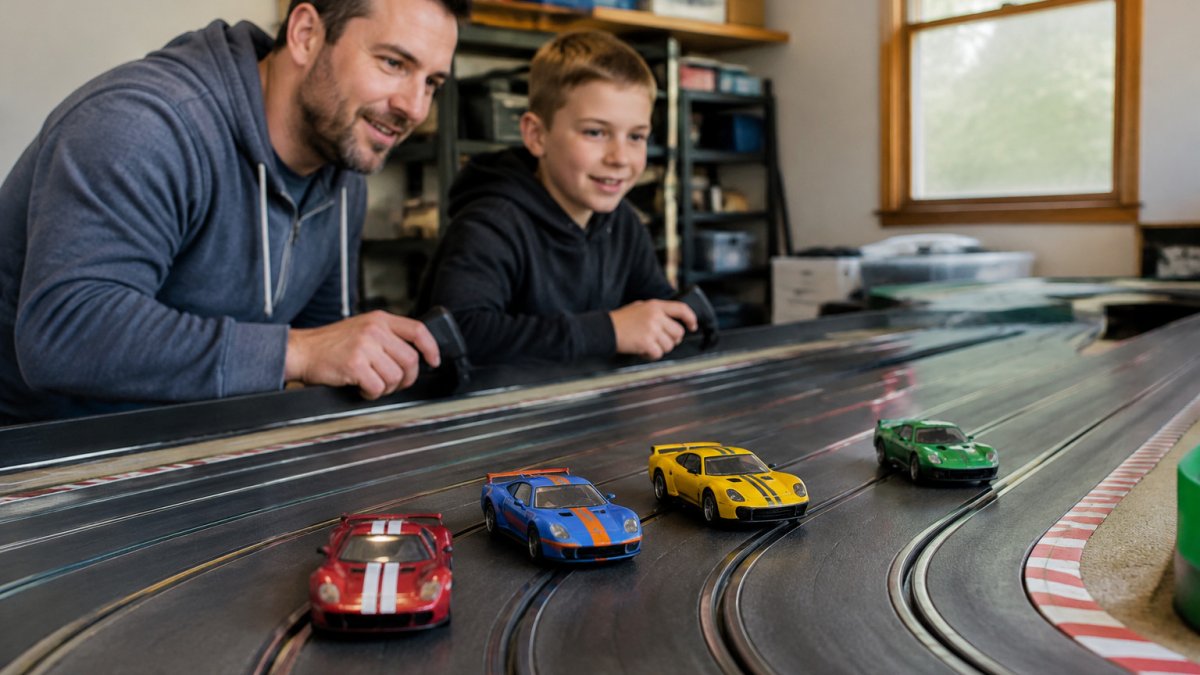
Slot car racing is a hobby where small cars run in a groove, or slot, cut into a track. The car is powered by electricity from the track and is steered by the groove itself.
Here is a simple way to start:
- Pick a starting set. Choose a complete beginner set with a track, cars, and a controller.
- Set up a flat, open space. Clear a table or floor area big enough for the full track layout.
- Connect the power supply. Plug in the power pack and connect the track, following the instructions.
- Test each car. Run every car slowly to check that it stays in the slot.
- Practice without racing. Spend a few laps learning how the throttle responds before you start a race.
- Add more cars or lanes later. Once you are comfortable, expand the track or try a new car.
Watch out: a set that comes off the track often usually has a loose rail or a worn car, not a bad driver. Check the track joins and tire condition before you blame yourself.
Digital vs Analog Slot Car Tracks: Which Should You Choose?
Digital and analog tracks both run slot cars on the same kind of slotted plastic or routed track, but they control the cars in fundamentally different ways.
Analog (traditional) track sends a fixed voltage through the two rails. The controller is essentially a variable resistor: press further, send more voltage, go faster. Every car on a lane gets the same voltage, so passing happens only by being faster in a corner or by the other driver's mistake.
Digital track still uses rails for power, but overlays a coded signal.
Here is how the trade-offs actually play out for a beginner:
- Compatibility: Analog cars generally will not run on a digital track without a decoder, and digital cars usually will not run on analog without conversion.
- Compatibility: Analog cars generally will not run on a digital track without a decoder, and digital cars usually will not run on analog without conversion. Track systems are often brand-specific. Decide on a track system first, then buy matching cars.
- Multi-car racing: Digital wins for more than two drivers or racing on a two-lane layout. Analog two-lane racing is simple and pure but caps you at two drivers.
- Learning curve: Analog teaches throttle and brake discipline directly. Digital is often gentler for beginners because braking can be adjusted in the chip, but it adds setup menus and chip programming.
- Tuning and modification: Analog cars are generally easier to modify, and many hobbyists enjoy tuning them.
A simple way to decide:
- Choose analog for the lowest entry cost, if you plan to tune and modify cars, or if you expect to race mostly one-on-one.
- Choose digital to race three or more drivers, for lane changing and ghost-car practice, or for race software tracking laps automatically.
- Choose either if you are only trying the hobby, but pick the track system you are most likely to stay with, because switching later means replacing cars and control gear, not just track.
Watch out: the most common first-purchase mistake is buying a digital set and then discovering that the analog cars you already own will not run on it without decoder chips.
The two systems differ in how they control the cars, and the main trade-offs for a beginner come down to a few points:
| Factor | Analog track | Digital track |
|---|---|---|
| Power control | Fixed voltage through the rails | Coded signal overlaid on the rails |
| Cars per lane | Two drivers at most | Several cars, lane changes possible |
| Car hardware | Plain cars, easy to tune | Decoder chip in each car |
| Learning curve | Teaches throttle and brake directly | Gentler braking, extra setup menus |
| Best for | Lowest cost, one-on-one racing | Three or more drivers, lap-counting software |
Slot Car Racing Equipment You Need for a First Setup
A first setup needs a few core parts, and the order you buy them in matters.
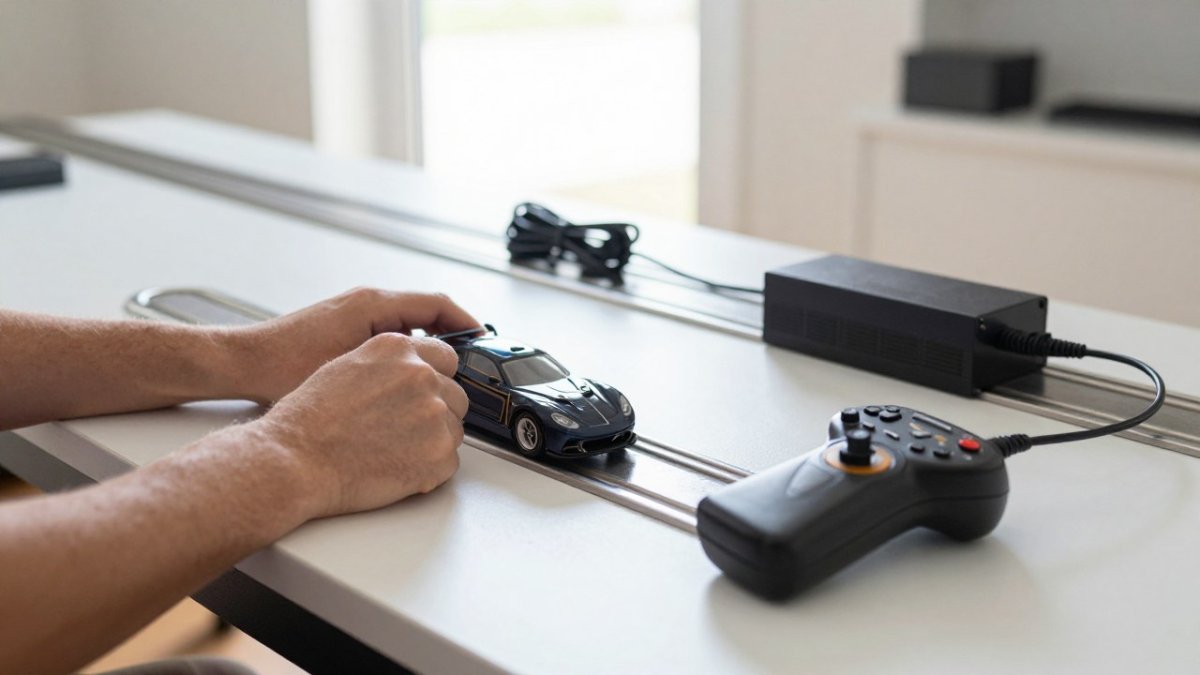
What a complete starter set usually includes: a loop or figure-eight of track, one or two cars, one or two controllers, a power supply, and sometimes a lap counter or bridge. What it often lacks: spare tires, tire cleaner, track cleaning erasers, extra track sections, or a second car if you want to race immediately.
Core equipment checklist:
- Track: A loop or figure-eight that fits your space. Measure the footprint, not just the track length, most sets need roughly the floor space of a small dining table.
- Cars: At least two, matched to the track system and scale, so you can race or compare lap times.
- Controllers: One per driver, matched to your track type. Analog controllers are simple resistor types; digital controllers may add buttons for braking or lane changes.
- Power supply: Sized for your track length and car count. Use the supply that came with the set or one rated for the same voltage and current; underpowered supplies cause inconsistent speed and false deslots.
- Cleaning supplies: A tire cleaner and soft cloth, plus a track-cleaning eraser or lint-free cloth for the rails. Clean rails and tires are the biggest factor in consistent grip.
Budget planning: Costs depend on the track system, scale, number of cars, and accessories you choose. For current prices, check Total Control SlotCar Racing's website or request a quote.
Compatibility rules to check before you buy:
- Scale: 1:32, 1:24, and 1:43 cars and track are not interchangeable. Pick one scale and stay with it.
- Track system: Track joiners and rail spacing are brand-specific. A car from one system usually will not run on another's track without an adapter or guide change.
- Power supply: Voltage and connector type must match the track and control unit. Do not mix supplies between systems.
- Controllers: Analog and digital controllers are not interchangeable, and some digital controllers are brand-specific.
- Digital components: Decoder chips, lane-change pieces, and control units must match the digital system. A chip from one brand will not work in another brand's system.
Track type also matters for maintenance.
Watch out: do not buy a second car or a digital upgrade until you have confirmed it matches your track system, scale, and controller type.
Slot Car Scales Explained: Choosing the Right Size
Slot cars come in several scales, and the scale you pick decides which parts and upgrades will fit.
Choose the scale that matches your goals and your idea of the hobby. A basic set from a toy section of a store is fine for a first try, but it will limit upgrades.
Think about what you want from the hobby before you buy:
- Casual fun: A starter set in a common scale is enough.
- Competitive racing: Pick a scale with a strong parts market and an active racing scene.
- Model building: Choose a scale with detailed car kits you can paint and modify.
Scale also affects track size. Larger scales need more room and longer track sections.
Slot Car Racing Tips for Beginners and Your Next Step at Total Control
Once your track is running, a few habits make the biggest difference to lap times. Start slow and focus on smooth throttle control through each corner, most new racers push too hard on the straights and spin out in the turns.
Here are a few common beginner mistakes to avoid:
- Overusing throttle. Ease off before the corner, not in it.
- Ignoring tire condition. Clean tires keep the car in the slot.
- Buying the cheapest parts first. Upgrades on a better car give more fun for the money.
- Skipping practice. A few laps a day beats one long session.
Many racers say the best next step is to race against other people. Total Control SlotCar Racing runs weekly racing events for all skill levels, and our track gives you a chance to test your skills and improve your lap times.
Frequently Asked Questions
How much does it cost to get started with slot car racing?
Costs depend on the track type, scale, number of cars, and whether you buy a complete set or build up gradually. Starter sets are usually the lowest-cost entry point, while upgrading to a larger or digital system raises the price. Pricing varies by quantity and product, so check Total Control SlotCar Racing's website for current prices or request a quote before you buy. Plan your budget around the track first, then add cars and accessories as you learn what you enjoy.
What is the difference between digital and analog slot car tracks?
Analog tracks give you direct control of car speed through a simple handheld throttle, so the driver manages power directly. Digital systems let each car's speed be set electronically, which allows multiple lanes with individual control and features such as lap timing. Digital can help manage speed while you learn, while analog is valued by hobbyists who enjoy hands-on tuning and a classic feel.
What scale slot car is best for beginners?
Scale determines the car size and how much room the track needs. A 1:32 scale is a common choice for home setups because it balances car availability, track footprint, and upgrade options. Larger scales such as 1:24 suit dedicated space and more detailed cars. Choose the scale that fits your available space and the kind of racing you want, and avoid mixing scales on the same track.
Can you use any slot car on any track?
Not always. Cars must match the track's scale and the system type, digital or analog, to run correctly. Mixing mismatched equipment can cause derailing, poor performance, or damage. Before buying, confirm that your cars and controllers are compatible with the track you plan to use, or check with the track manufacturer for compatibility details.
